
Your needs, this model
Does it fit your priorities?
Does a three-cup/24-ounce handled bowl fit the small batches you repeat?
The manual labels the DLC-2A Series2 bowl three cups and the current pages call it 24 ounces. The processed-food rule is lower than the whole bowl: keep food no more than two-thirds up the blade hub and follow the separate task table.
Explore this need in the finder →Do you need one compact bowl with both Chop and Grind modes?
Yes. One auto-reversing blade exposes its sharp edge for Chop and blunt edge for Grind. That documents small hard-food grinding, not a separate grinder jar or large-volume mill.
Explore this need in the finder →Is a measured nut-batch minimum essential?
The DLC-2A Series2 booklet discusses nuts but does not set a numeric nut quantity, so a required amount should not be inferred from its three-cup bowl. Cuisinart ECH-4SV and MCH-4 manuals document one-cup nut batches; the CCH-3 manual documents one-half cup.
Explore this need in the finder →Must every removable part be confirmed top-rack safe?
Cuisinart calls removable parts dishwasher-safe, and the booklet gives top-rack guidance for the bowl, cover and blade assembly while directing the blade to the cutlery basket. It does not clearly extend that guidance to the spatula, so a strict all-parts top-rack need is not verified.
Explore this need in the finder →Do you need feed-tube slicing, shredding or dicing in the same package?
No. The Mini-Prep Plus is a small bowl-and-blade chopper without a feed tube, slicing/shredding disc or dicing kit. A larger processor with the exact included cutting tool is the better fit for those essential jobs.
Explore this need in the finder →Cuisinart · Compact chopper
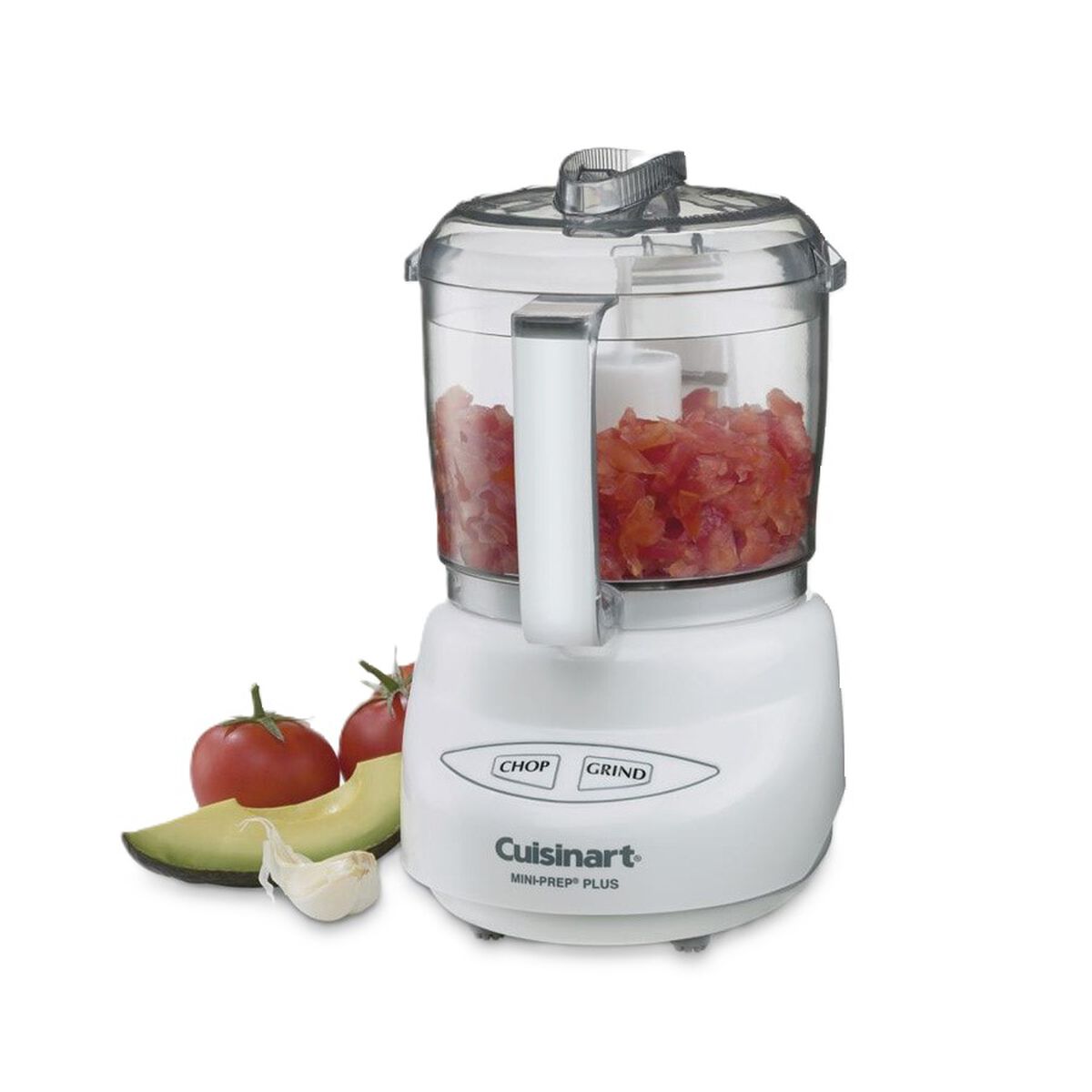
The Mini-Prep Plus is a small-batch processor, not a scaled-down replacement for a full-size bowl machine. Its 24-ounce work bowl is the same three-cup capacity described in the manual. The current U.S. listings cover three finishes: white DLC-2A, pink DLC-2APK, and brushed-chrome DLC-2ABC. Their listed core package is consistent: handled bowl and cover, one reversible SmartPower blade, spatula, and instruction/recipe booklet. The manufacturer lists a 250-watt motor, 5 × 7 × 9.25-inch dimensions, and an 18-month limited warranty for the current versions.
One blade, two jobs
Rather than swapping between separate chopping and grinding blades, the Mini-Prep Plus reverses one stainless-steel blade. Chop presents its sharp edge for herbs, onions, garlic, dips, purées, mixing, and emulsifying; Grind turns the blunt edge toward dry or hard ingredients such as spices, peppercorns, seeds, chocolate, and nuts. The two touchpad buttons make the distinction visible, but the bowl is still a small shared work space—not a grinder jar or a grain mill. If a spice session leaves visible marks, that is a manual-described cosmetic tradeoff, not proof the bowl has failed.
For chop work, use short pulses and check the texture early. Cuisinart warns that over-processing can turn a fine chop into a wet paste. Grind mode is intended for longer holds, yet the manual adds two important boundaries: after about ten seconds, pulse about every ten seconds to let food fall back down, and never run continuously longer than one minute. The manufacturer also recommends supporting the compact appliance with one hand while it runs. These are useful instructions for planning brief batches; they are not a promise that every ingredient will reach a particular texture.
The bowl label is not a batch chart
Three cups (24 ounces) describes the rated bowl, not a universal amount of food to process at once. The booklet says processed food should not rise more than two-thirds of the way up the blade assembly's central hub, and its task chart gives narrower limits: up to three ounces of hard cheese, 1.5 ounces of chocolate, four ounces of fresh ginger or horseradish, eight ounces of meat, and three-quarters of a cup of butter. The manual gives techniques for nuts but no specific nut-batch quantity. If a measured nut allowance is essential, do not treat the larger bowl label as a substitute; the four-cup Cuisinart ECH-4SV and MCH-4 manuals each list a one-cup nut batch, while the smaller CCH-3 booklet lists one-half cup.
That difference matters when you set the finder. A three-cup bowl minimum and a documented Grind mode can bring this product into a shortlist. Adding a 4-cup minimum removes it, as it should. A required numeric nut-batch threshold should also leave it out because its manual does not state one. Likewise, a strict top-rack requirement for every removable piece is not confirmed by the text we found: the booklet names the bowl, cover, and blade assembly for top-rack washing, with the blade placed in the cutlery basket, but it does not clearly extend that instruction to the supplied spatula.
Where it stops
The listed Mini-Prep package is built around that handled bowl and reversing blade. It does not include a feed tube, slicing or shredding disc, dicing grid, French-fry disc, whisk, dedicated dough blade, second work bowl, or separate grinding cup. Its lid has two small openings through which the manual permits adding a liquid while running—one opening at a time, leaving the other free for air. That is not a feed-tube setup for processing a steady stream of produce. If your recurring work is slicing, shredding, dicing, kneading with a dedicated blade, or larger batches, move to a processor package that lists those tools rather than expecting this mini chopper to stretch into those jobs.
Cleaning is simple in principle: Cuisinart calls the removable parts dishwasher-safe, and the booklet specifies the top rack for the work bowl, cover, and blade assembly. Put the blade in the cutlery basket and handle it as a sharp knife; wipe the motor base with a damp cloth rather than immersing it. The manual says hard spices and grains may scratch the bowl and cover without affecting function. It suggests reserving the original set for grinding and obtaining another bowl and cover if appearance matters, but those parts are sold separately and are not an included second bowl.
There is also a counter-space catch. At 9.25 inches tall, the assembled machine stores easily in many kitchens, but the booklet says not to operate it beneath a wall cabinet or inside an appliance garage. Treat the published height as storage sizing, then move it to open counter space before processing. The same booklet limits the unit to household use and says it is designed for 120-volt outlets; it is not a commercial-use recommendation.
Current color choices and alternatives
The three active pages differ in finish rather than the listed functional package. DLC-2A is white; DLC-2APK is pink; DLC-2ABC is brushed chrome. The DLC-2ABC headline says “3-Cup Capacity,” while its body says “24 ounce” bowl. Those are equivalent descriptions of the same stated bowl volume, not two capacities. Cuisinart also retains discontinued pages for earlier colors—including Onyx DLC-2AOM, Lime DLC-2AG, Tangerine DLC-2ADY, Magenta DLC-2AM, Metallic Red DLC-2AMR, Turquoise DLC-2ATQ, Red DLC-2AR, Peridot DLC-2APM, Black DLC-2ABK, and Sapphire DLC-2ASM. They share the linked DLC-2A Series booklet and listed small-bowl function, but the manufacturer marks them discontinued; they are useful references, not current buying choices.
Choose the Mini-Prep Plus when a tiny footprint, two documented blade modes, and a three-cup bowl answer the jobs you actually repeat. Compare the CCH-3 if its own manual's half-cup nut amount and BladeLock matter more; choose ECH-4SV or MCH-4 when a four-cup bowl and their one-cup nut allowance fit better. For cutting discs or large-batch prep, compare the Cuisinart FP-5 or FP-7 instead. The exact sources for this assessment are Cuisinart's DLC-2A, DLC-2APK, and DLC-2ABC product pages and the linked 25-page DLC-2A Series instruction booklet.
Key details at a glance
| Rated work-bowl capacity | 3 cups |
|---|---|
| Extra-large feed tube identified | No |
| Dicing kit included | No |
| French-fry disc included | No |
| Dough blade included | No |
| Refrigerator lid included | No |
| Whisk accessory included | No |
| Fine/thin and medium shredding options included | No |
| Thin/medium/thick disc set included | No |
| Dedicated thick-slicing disc included | No |
| Published appliance height | 9.25 in |
| Household power supply | 120 V outlet; corded household appliance |
| Drizzle basin included | No |
| Additional work bowl confirmed | No |
| Manufacturer-rated motor power | 250 W |
| Adjustable slicing disc included | No |
| Medium shredding disc included | No |
| Removable parts dishwasher-safe | Yes |
| Continuous-feed attachment included | No |
| Dedicated Grind function documented | Yes |
| Slicing/shredding disc included | No |
| Published width | 7 in |
Use the exact model’s instructions for operating limits, supplied equipment and version differences.
Sources for this assessment
- Cuisinart Mini-Prep Plus 24 Ounce Processor DLC-2A (White)
- Cuisinart Mini-Prep Plus 24 Ounce Processor DLC-2APK (Pink)
- Cuisinart Mini Food Processor DLC-2ABC (Brushed Chrome)
- Cuisinart Mini-Prep Plus Processor DLC-2A Series2 instruction and recipe booklet
- Cuisinart DLC-2A parts and accessories listing
- Cuisinart replacement work bowl compatibility list
- Cuisinart Work Bowl Cover DLC-2AWBC-1
- Cuisinart Spatula DLC-192TX-1
- Cuisinart Work Bowl and Cover Combo DLC-2ABS-1
- Cuisinart Chopping Blade DLC-2ACBN
- Cuisinart Mini-Prep Plus DLC-2AOM (Onyx) discontinued exact page
- Cuisinart Mini-Prep Plus DLC-2AG (Lime) discontinued exact page
- Cuisinart Mini-Prep Plus DLC-2ADY (Tangerine) discontinued exact page
- Cuisinart Mini-Prep Plus DLC-2AM (Magenta) discontinued exact page
- Cuisinart Mini-Prep Plus DLC-2AMR (Metallic Red) discontinued exact page
- Cuisinart Mini-Prep Plus DLC-2ATQ (Turquoise) discontinued exact page
- Cuisinart Mini-Prep Plus DLC-2AR (Red) discontinued exact page
- Cuisinart Mini-Prep Plus DLC-2APM (Peridot) discontinued exact page
- Cuisinart Mini-Prep Plus DLC-2ABK (Black) discontinued exact page
- Cuisinart Mini-Prep Plus DLC-2ASM (Sapphire) discontinued exact page
- Cuisinart Mini-Prep Plus exact discontinued model page DLC-2ABM (Blue Mint)
- Cuisinart Mini-Prep Plus exact discontinued model page DLC-2ACY (Chocolate Cherry)
- Cuisinart Mini-Prep Plus exact discontinued model page DLC-2ADB (Deep Blue)
- Cuisinart Mini-Prep Plus exact discontinued model page DLC-2ADG (Green)
- Cuisinart Mini-Prep Plus exact discontinued model page DLC-2ADP (Grape)
- Cuisinart Mini-Prep Plus exact discontinued model page DLC-2ADR (Raspberry)
- Cuisinart Mini-Prep Plus exact discontinued model page DLC-2AKL (Key Lime)
- Cuisinart Mini-Prep Plus exact discontinued model page DLC-2ALB (Light Blue)
- Cuisinart Mini-Prep Plus exact discontinued model page DLC-2ALG (Light Green)
- Cuisinart Mini-Prep Plus exact discontinued model page DLC-2ALP (Light Pink)
- Cuisinart Mini-Prep Plus exact discontinued model page DLC-2ALY (Light Yellow)
- Cuisinart Mini-Prep Plus exact discontinued model page DLC-2AO (Orange)
- Cuisinart Mini-Prep Plus exact discontinued model page DLC-2APAP (Papaya)
- Cuisinart Mini-Prep Plus exact discontinued model page DLC-2APCH (Pink Champagne)
- Cuisinart Mini-Prep Plus exact discontinued model page DLC-2ASP (Plum)
- Cuisinart Mini-Prep Plus exact discontinued model page DLC-2AWM (Watermelon)
- Cuisinart Mini-Prep Plus exact discontinued model page DLC-2ABL (Blue)
- Cuisinart Mini-Prep Plus exact discontinued model page DLC-2APF (Purple)
Choose a tool set for your usual prep.
Compare exact tools and manual limits: Cuisinart Mini-Prep Plus DLC-2A and DLC-4CHB, CCH-3, ECH-4SV and MCH-4 Chop/Grind batches; Hamilton Beach 70450 bowl and reversible-disc tasks; the 70510’s documented bowl-based smoothie method and slicing disc; FP-5 and FP-7 bowls; the FP-9CF continuous-feed setup; KitchenAid choppers; and larger processors. Hamilton Beach 70585 adds a 14-cup bowl, nested 4-cup chop/puree bowl, a dough blade for up to 4 cups flour and top-rack care; compare its separate task caps before batch prep. For a 10-cup bowl with a lid-operated scraper, compare the Hamilton Beach 70730J; its scraper is limited to blade work, and the manual rules out kneading dough, ice crushing and grinding. Hamilton Beach 70723G adds a 10-cup Stack & Snap package with a two-minute manual motor-on limit; it has no dough blade or scraper. The Hamilton Beach 70740G offers an eight-cup bowl with a reversible disc; its manual limits produce and cheese batches below the headline bowl size and rules out dough, ice-crushing and dry-grinding. The white 70733 adds a page-listed 10-cup scraper package, but its linked manual labels 70730/70731; do not carry those operating limits over. Compare it only for exact page-backed tools and keep top-rack, scraper/disc compatibility and task limits unknown. Breville adds two nine-cup choices: the Sous Chef 9 BFP610 has an adjustable slicer and dough blade without a standard-box dicing grid, while the Paradice 9 BFP638 includes a half-inch dicing kit. Compare the <a href="/learn/breville-sous-chef-9-vs-paradice-9/">two Breville nine-cup packages</a> by tool list, manual care and listed body height. Compare Breville’s current Paradice 12 BFP738 and Paradice 16 BFP838 by their distinct bowl sizes, dicing grids, included mini bowl and fry disc in the <a href="/learn/breville-paradice-12-vs-16/">Paradice 12-versus-16 guide</a>. Compare the BFP800 Pro, BFP810 and BFP820 Peel & Dice by their separate packages in the <a href="/learn/breville-sous-chef-16-bfp800-810-820/">Sous Chef 16 family guide</a>: the included grid, peeler and mini-bowl details change the answer. Ninja TotalCrush IQ801BK is a three-vessel hybrid with one 8-cup processor bowl, a separate 72-ounce pitcher and a separate 24-ounce tumbler; compare its chopping/dough tool list with CrushBOSS slice/shred/crinkle and dicing packages. Braun EasyPrep package choices also differ: FP3101BK lists one fixed 4 mm reversible slicing/grating disc; FP3211SI lists fixed 2 mm and 4 mm discs plus a dough tool; CH3012BK is the small chopper with a listed mayonnaise accessory and separate 0.5 L working-capacity figure. Vitamix SmartPrep systems combine an Ascent blender with a separate SELF-DETECT processor attachment: X2 has three blender programs, X4 itemizes julienne and veggie-stick discs, and X5 lists ten blender programs but the standard processor discs. X5 Deluxe adds a blending cup-and-bowl kit, not a second processor bowl. The attachment manual sets 12 cups dry, 8 wet and a three-minute continuous-use ceiling. Oster adds a white six-cup blender and three-cup processor attachment in SAP 2197995; compare that format with the glass-jar 6878 chopper and the ten-cup 2142993 bowl processor in the Oster package guide. Proctor Silex has two earlier sizes worth distinguishing: the 72706 is a three-cup mini processor with an oil-dispenser lid and small-quantity adjuster, while the 70810 is a nine-cup Quick Clean model with a reversible slice/shred disc. Both exact pages say No Longer Available; their manuals do not support every task a larger bowl might suggest.