
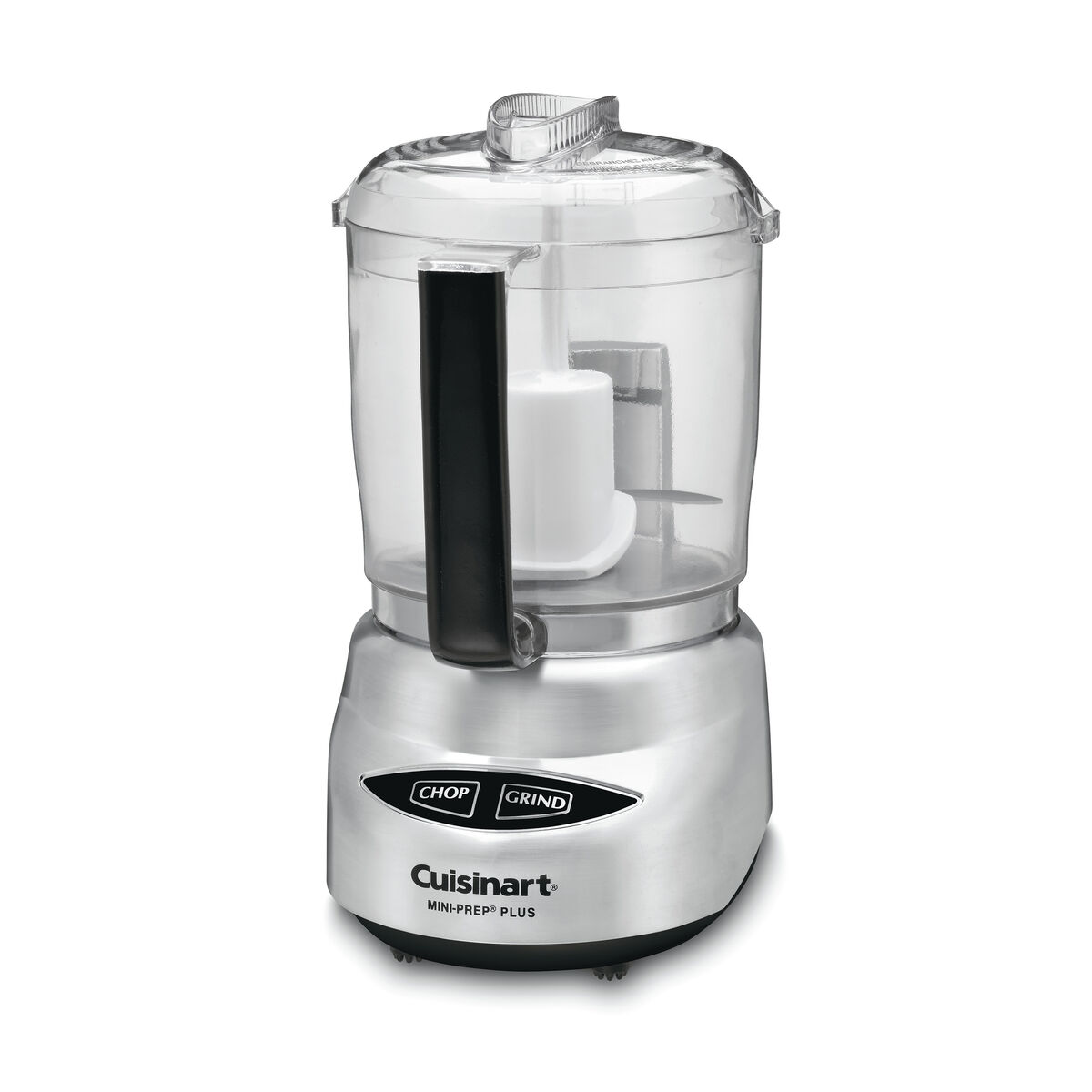
Your needs, this model
Does it fit your priorities?
Would a four-cup bowl and a one-cup nut batch cover your frequent small prep?
The four-cup number is the bowl rating; Cuisinart's linked booklet separately lists up to one cup of nuts under Chop. That amount is specific to the nut task and is not a one-cup Grind capacity for every hard ingredient.
Explore this need in the finder →Do you need a distinct Grind control for small quantities of spices or hard, dry ingredients?
Yes: the current package has Chop and Grind touchpads, and the linked booklet describes Grind for spices, peppercorns, seeds and chocolate. It reverses the same blade; there is no separate grinder jar or mill.
Explore this need in the finder →Do you need a real feed tube, slicing or shredding discs, or a dicing grid?
No such tools are listed in the exact DLC-4CHB package or its parts/manual view. For repeated slices, shreds or diced pieces, choose a processor package whose included disc or grid matches that job.
Explore this need in the finder →Can you keep the bowl and cover away from cosmetic scratches during spice grinding?
The manual warns hard spice and grain grinding may scratch the bowl and cover without impairing function. It suggests reserving a bowl for that work or obtaining a separate bowl and cover, which Cuisinart lists as replacement parts rather than included extras.
Explore this need in the finder →A four-cup bowl for compact prep, not a small disc processor
Cuisinart's Mini-Prep Plus DLC-4CHB is the Brushed Chrome 4-cup version of its compact Chop/Grind chopper. The current U.S. product page lists a handled work bowl and cover, a single auto-reversing SmartPower blade, two touchpad controls, a spatula, an instruction-and-recipe booklet, a 250-watt motor and an 18-month limited warranty. Its listed body dimensions are 5.38 by 7.63 by 9.94 inches. Those specifications describe the actual package better than the broad phrase “food processor”: the bowl has no produce feed tube or slicing, shredding, dicing or French-fry tools.
The two controls do not swap in a second cutting attachment. Chop presents the sharp edge for soft ingredients and short, controlled cuts; Grind reverses the same blade so its blunt edge handles hard or dry foods. The booklet names herbs, garlic, onions, cooked vegetables, dressings and small purees among appropriate Chop jobs, and calls out hard spices, peppercorns, seeds and chocolate for Grind. For a cook who repeatedly prepares a small salsa base, herbs for a dressing, a little puree or a pinch-bowl of spice, that compact single-bowl setup is more useful than unused discs. For repeated whole-vegetable slicing or larger prep, it is the wrong kind of machine.
Four cups is the bowl rating, not the batch promise
Use the linked booklet's ingredient chart to size the task. It lists up to one cup of nuts under Chop; do not turn that into a one-cup Grind rating or assume that any ingredient can fill the bowl to its four-cup label. The same chart gives separate examples such as up to eight ounces of meat, four ounces of fresh ginger and one and a half ounces of chocolate. Those are task-specific amounts rather than a general load line. The booklet also says not to overload the bowl and gives a general post-processing reference to the blade assembly's central hub. The product page FAQ instead describes an approximately two-thirds-full bowl for uniform half-inch-to-one-inch pieces. Because these two directions name different reference points, the conservative plan is to use the manual chart and stop when the food reaches its listed amount rather than treating capacity as a universal batch size.
Texture depends on the rhythm as much as on the bowl. For chopping, the booklet favors brief pulses and frequent checks; staying too long can turn a coarse cut watery. For hard ingredients, it describes a longer Grind hold and recommends pulsing about every ten seconds after a longer run so material can fall back toward the blade. It also says never to operate continuously for more than one minute at a time. There is an inconsistency inside the same booklet: its hummus recipe describes a 1.5-to-2-minute processing step, and other recipe directions accumulate more than a minute of run time, yet the general instruction sets the one-minute continuous ceiling. The booklet does not give a separate cooling or restart interval. Treat one minute as the maximum for a continuous run; do not infer an unstated motor duty cycle from a recipe duration.
Make room for the tradeoffs
Grinding can leave cosmetic marks. The booklet warns that hard spices and grains may scratch the clear bowl and cover but says that the marks do not impair function. It suggests reserving a bowl for grinding or acquiring a separate bowl-and-cover set. Cuisinart's exact DLC-4CHB parts page lists a replacement work bowl, cover, chopping blade and spatula, but those repair items are not additional contents of the standard package. The blade is sharp: unplug before taking it apart, wait for it to stop moving and hold the center hub rather than the cutting edge. The manual permits the removable bowl, cover, blade assembly and spatula on the dishwasher's top rack (placing the blade and spatula in the cutlery basket); the motor base should be wiped, not immersed. A hidden cord-storage feature keeps spare cord beneath the base.
Exact-model identity matters within the Cuisinart compact range. The Mini-Prep Plus DLC-2A is labeled at 24 ounces, equivalent to three cups, while this DLC-4CHB page states four cups and 250 watts. Both use a reversing Chop/Grind blade, but the DLC-2A booklet does not quantify its nut batch; that amount should stay unknown rather than inherit DLC-4CHB's chart. CCH-3 is another three-cup model whose own manual lists one-half cup of nuts. ECH-4SV and Core Custom MCH-4 are separate four-cup alternatives whose booklets each list a one-cup nut batch; MCH-4 also has a BladeLock. These are genuinely different model packages, not color variants of DLC-4CHB.
When choosing in a finder, a four-cup minimum and one-cup nut need can fit this DLC-4CHB plan, and a Grind-control requirement can be asked separately. Raising the nut minimum above one cup should remove it; selecting dicing, slicing, shredding, a feed tube, a whisk or a dedicated dough blade should also remove it because none is listed for this package. Do not select DLC-4CHB just because a seller uses “processor” in a title if disc work is essential. Consider a larger bowl processor such as FP-7 for slicing and shredding, or the exact KitchenAid KFP1319 package when a documented dicing grid matters. If a one-minute run ceiling or unclear recipe-run language conflicts with your long blending routine, a larger machine with a clearer operating plan is the safer fit.
The exact Cuisinart page is currently active, but the review records no price or stock promise. Its directly linked 13-page booklet has an unusual identity wrinkle: the cover artwork says DLC-4ACHW, while the interior title names DLC-4CHB. That direct link and interior code support the assessment, but the suffix discrepancy is not erased. The product image is the exact page-linked Brushed Chrome body and bowl; whether it is a photograph, composite or render is not disclosed. This is a source-based assessment, not hands-on or laboratory testing.
Key details at a glance
| Rated work-bowl capacity | 4 cups |
|---|---|
| Extra-large feed tube identified | No |
| Dicing kit included | No |
| French-fry disc included | No |
| Dough blade included | No |
| Refrigerator lid included | No |
| Whisk accessory included | No |
| Fine/thin and medium shredding options included | No |
| Thin/medium/thick disc set included | No |
| Dedicated thick-slicing disc included | No |
| Published appliance height | 9.94 in |
| Household power supply | Corded household appliance; voltage not stated on the exact product page or directly linked booklet. |
| Drizzle basin included | No |
| Additional work bowl confirmed | No |
| Manufacturer-rated motor power | 250 W |
| Adjustable slicing disc included | No |
| Medium shredding disc included | No |
| Removable parts dishwasher-safe | Yes |
| Continuous-feed attachment included | No |
| Dedicated Grind function documented | Yes |
| Manual-listed nut batch capacity | 1 cups |
| Slicing/shredding disc included | No |
| Top-rack dishwasher-safe removable parts | Yes |
| Published width | 7.63 in |
Use the exact model’s instructions for operating limits, supplied equipment and version differences.
Sources for this assessment

Choose a tool set for your usual prep.
Compare exact tools and manual limits: Cuisinart Mini-Prep Plus DLC-2A and DLC-4CHB, CCH-3, ECH-4SV and MCH-4 Chop/Grind batches; Hamilton Beach 70450 bowl and reversible-disc tasks; the 70510’s documented bowl-based smoothie method and slicing disc; FP-5 and FP-7 bowls; the FP-9CF continuous-feed setup; KitchenAid choppers; and larger processors. Hamilton Beach 70585 adds a 14-cup bowl, nested 4-cup chop/puree bowl, a dough blade for up to 4 cups flour and top-rack care; compare its separate task caps before batch prep. For a 10-cup bowl with a lid-operated scraper, compare the Hamilton Beach 70730J; its scraper is limited to blade work, and the manual rules out kneading dough, ice crushing and grinding. Hamilton Beach 70723G adds a 10-cup Stack & Snap package with a two-minute manual motor-on limit; it has no dough blade or scraper. The Hamilton Beach 70740G offers an eight-cup bowl with a reversible disc; its manual limits produce and cheese batches below the headline bowl size and rules out dough, ice-crushing and dry-grinding. The white 70733 adds a page-listed 10-cup scraper package, but its linked manual labels 70730/70731; do not carry those operating limits over. Compare it only for exact page-backed tools and keep top-rack, scraper/disc compatibility and task limits unknown. Breville adds two nine-cup choices: the Sous Chef 9 BFP610 has an adjustable slicer and dough blade without a standard-box dicing grid, while the Paradice 9 BFP638 includes a half-inch dicing kit. Compare the <a href="/learn/breville-sous-chef-9-vs-paradice-9/">two Breville nine-cup packages</a> by tool list, manual care and listed body height. Compare Breville’s current Paradice 12 BFP738 and Paradice 16 BFP838 by their distinct bowl sizes, dicing grids, included mini bowl and fry disc in the <a href="/learn/breville-paradice-12-vs-16/">Paradice 12-versus-16 guide</a>. Compare the BFP800 Pro, BFP810 and BFP820 Peel & Dice by their separate packages in the <a href="/learn/breville-sous-chef-16-bfp800-810-820/">Sous Chef 16 family guide</a>: the included grid, peeler and mini-bowl details change the answer. Ninja TotalCrush IQ801BK is a three-vessel hybrid with one 8-cup processor bowl, a separate 72-ounce pitcher and a separate 24-ounce tumbler; compare its chopping/dough tool list with CrushBOSS slice/shred/crinkle and dicing packages. Braun EasyPrep package choices also differ: FP3101BK lists one fixed 4 mm reversible slicing/grating disc; FP3211SI lists fixed 2 mm and 4 mm discs plus a dough tool; CH3012BK is the small chopper with a listed mayonnaise accessory and separate 0.5 L working-capacity figure. Vitamix SmartPrep systems combine an Ascent blender with a separate SELF-DETECT processor attachment: X2 has three blender programs, X4 itemizes julienne and veggie-stick discs, and X5 lists ten blender programs but the standard processor discs. X5 Deluxe adds a blending cup-and-bowl kit, not a second processor bowl. The attachment manual sets 12 cups dry, 8 wet and a three-minute continuous-use ceiling. Oster adds a white six-cup blender and three-cup processor attachment in SAP 2197995; compare that format with the glass-jar 6878 chopper and the ten-cup 2142993 bowl processor in the Oster package guide. Proctor Silex has two earlier sizes worth distinguishing: the 72706 is a three-cup mini processor with an oil-dispenser lid and small-quantity adjuster, while the 70810 is a nine-cup Quick Clean model with a reversible slice/shred disc. Both exact pages say No Longer Available; their manuals do not support every task a larger bowl might suggest.