
Your needs, this model
Does it fit your priorities?
How much liquid does the exact 72870 guide allow in the bowl?
The 3 1/2-cup bowl has a lower, explicit 1-cup maximum for liquid ingredients; the rating is not a liquid-fill target.
Explore this need in the finder →Will the 72870 cover slicing, shredding or dicing?
No. The exact parts list shows a chopping blade, not a slicer/shredder disc or grid dicer. Choose a processor package that names those tools if they are essential.
Explore this need in the finder →What should you expect to process in one small batch?
The manual chart lists up to 1 1/2 cups of cut vegetables or fruit and up to one cup of chopped nuts or herbs; the motor/base is intended for small household quantities, not large meal-prep batches.
Explore this need in the finder →Does the manual document a long uninterrupted motor-on interval?
No maximum interval is published. It describes short press/release processing and recipes but does not establish a continuous-run ceiling; a longer required interval stays unverified.
Explore this need in the finder →A compact chopper for measured small batches
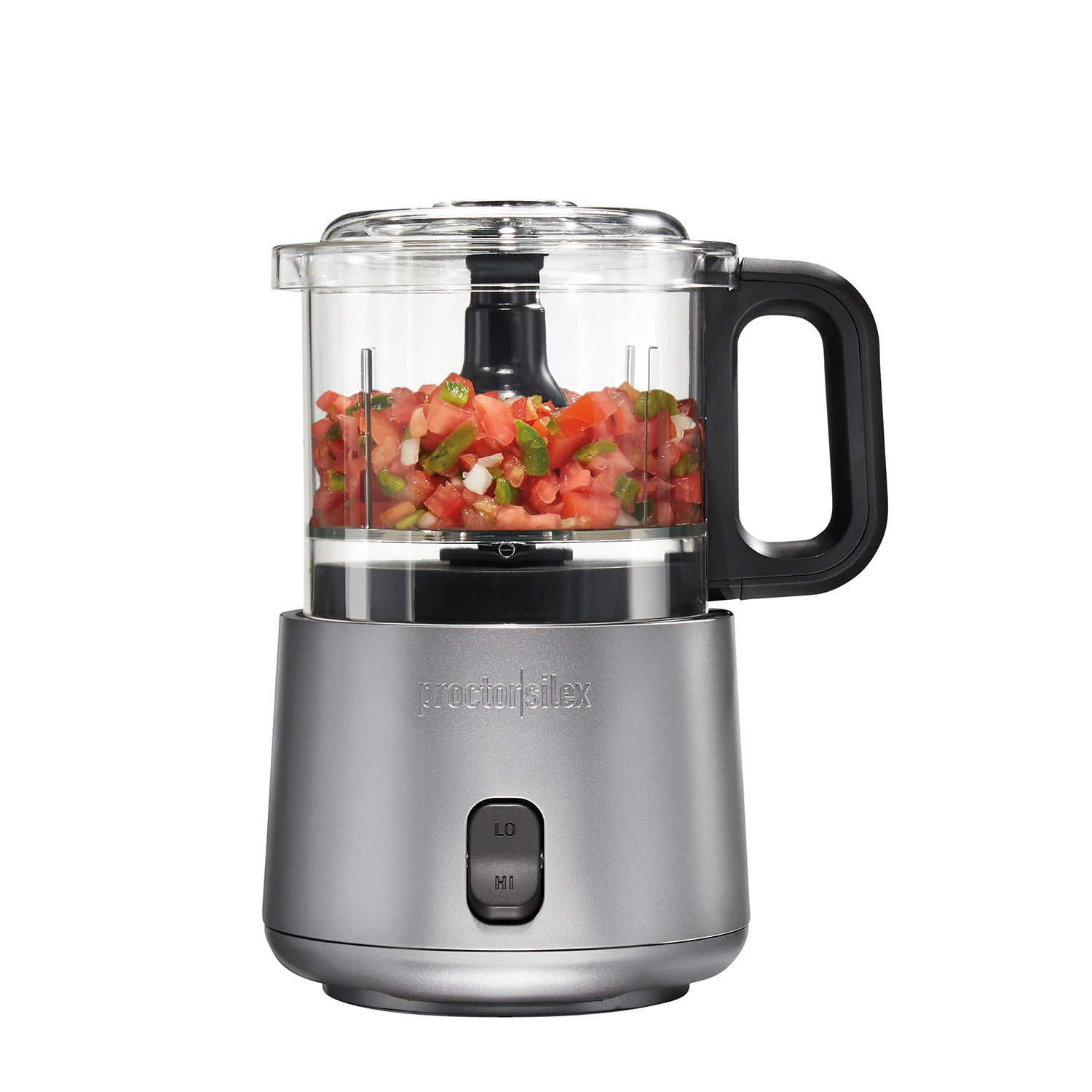
The Proctor Silex 72870 is an earlier 3.5-cup food chopper with one chopping blade, a lid-mounted oil dispenser, an LO/HI switch and a press-to-run lid. The exact Use & Care guide identifies the unit as model 72870, Type FC14, rated for a 120 V / 60 Hz outlet at 350 watts. Its guide is unusually useful for deciding whether “3.5 cups” fits a real routine: the bowl rating is not an instruction to fill the whole bowl with liquid or a promise of a 3.5-cup batch of every ingredient.
For example, the manual limits liquid ingredients to one cup, lists up to 1½ cups of cut vegetables or fruit, and gives one-cup amounts for nuts and herbs. Parmesan is a half-cup task in its chart. Those are better planning numbers than a generic bowl label if your recurring job is salsa, hummus, crumbs, herbs or a small dressing. The guide specifically suggests pulsing separate components for pico de gallo and guacamole, then combining them, rather than dumping everything in together and hoping for evenly textured results.
What the two controls actually add
The page describes “two pulse speeds,” but the guide calls them LO and HI: choose one, then press the lid to run and release it to stop. Brief press-and-release cycles give you a way to check texture as you go. It is not a programmed pulse sequence or a timer. The guide does not publish a longest continuous run interval, so shoppers with a hard minimum such as one minute uninterrupted should treat that requirement as unknown, not assume the motor can safely run for that long.
The oil dispenser built into the lid is the clearest package advantage beyond a basic chopping bowl. It is intended to let oil enter gradually while making dressing, mayonnaise or other emulsions. This is a lid feature, not a separate whisk, liquid blender or additional bowl. If you primarily need mayonnaise or sauce in small quantities, that design may be useful; if your work is mostly shredding cheese, slicing vegetables or batch-prepping a week of ingredients, the included single chopping blade is the wrong tool set.
Check the included tools against your menu
The exact parts diagram lists the bowl, oil-dispenser lid, chopping blade, motor shaft, base, LO/HI switch, cord and cord reel. It does not identify a slicing or shredding disc, a grid dicer, a French-fry cutter, a dough blade, a second work bowl or a separate Grind control. Do not infer those abilities from the phrase “food processor” in a product title. If those are essential jobs, use the questionnaire to require the specific attachment or compare a different package. A 3.5-cup rating does not compensate for a missing cutter.
There are also limits a buyer should take seriously. The manual says not to process raw meat, coffee beans or whole hard spices. It describes small quantities for immediate consumption, not large batches. The bowl, lid and blade may go on the dishwasher’s top rack; the motor base is wiped, not immersed. The manufacturer gives a three-year limited warranty for the U.S. and Canada, but that coverage relates to the original purchase and does not make a used unit an easy warranty proposition.
Storage and availability are part of the decision
The manufacturer lists the body at 9.4 inches deep, 7.5 wide and 6 high, plus a 30-inch cord that winds into a reel underneath the base. That low height may be convenient for a shelf, but the depth still deserves measuring before buying for a shallow cupboard. A main image on the official page shows the gray/silver base, clear handled bowl, lid and two-level switch; the staged ingredients are illustrative rather than a test result.
Most importantly, Proctor Silex currently marks the exact 72870 page “No Longer Available.” That is a dated manufacturer page status, not evidence that every used listing is unsafe or that no remaining offer exists. Treat this review as an earlier-model reference, check that a secondhand item really carries the 72870 label, and inspect the sharp blade, lid, bowl, cord and safety interlock before considering any particular unit. A current 1.5-cup Proctor Silex chopper is smaller and does not replace this model’s two-level control or 3.5-cup bowl; a current 3- or 4-cup Cuisinart may be a better route when availability and simpler sourcing matter more than this exact oil-dispensing layout.
Bottom line: The 72870 is worth understanding if you want an inexpensive-format, small-batch reference with a manual-backed liquid limit, an oil-dispenser lid and a cord reel. Its practical task capacities are much lower than its bowl rating, its toolkit is limited to chopping, and its manufacturer page no longer offers it. If you need a current processor for repeated slicing, shredding or larger batches, compare a live exact package rather than treating an old product page as a shopping signal.
Sources: Proctor Silex 72870 product page and the manufacturer-linked Use & Care guide 840358300.
Key details at a glance
| Rated work-bowl capacity | 3.5 cups |
|---|---|
| Dicing kit included | No |
| French-fry disc included | No |
| Dough blade included | No |
| Refrigerator lid included | No |
| Whisk accessory included | No |
| Published appliance height | 6 in |
| Household power supply | 120 V / 60 Hz household outlet |
| Drizzle basin included | Yes |
| Additional work bowl confirmed | No |
| Manufacturer-rated motor power | 350 W |
| Removable parts dishwasher-safe | Yes |
| Continuous-feed attachment included | No |
| Dedicated Grind function documented | No |
| Manual maximum wet fill | 1 cups |
| Slicing/shredding disc included | No |
| Top-rack dishwasher-safe removable parts | Yes |
| Published width | 7.5 in |
| Published depth/length | 9.4 in |
| Limited warranty term | 3 years |
| Grating disc/function explicitly included | No |
Use the exact model’s instructions for operating limits, supplied equipment and version differences.
Sources for this assessment

Choose a tool set for your usual prep.
Compare exact tools and manual limits: Cuisinart Mini-Prep Plus DLC-2A and DLC-4CHB, CCH-3, ECH-4SV and MCH-4 Chop/Grind batches; Hamilton Beach 70450 bowl and reversible-disc tasks; the 70510’s documented bowl-based smoothie method and slicing disc; FP-5 and FP-7 bowls; the FP-9CF continuous-feed setup; KitchenAid choppers; and larger processors. Hamilton Beach 70585 adds a 14-cup bowl, nested 4-cup chop/puree bowl, a dough blade for up to 4 cups flour and top-rack care; compare its separate task caps before batch prep. For a 10-cup bowl with a lid-operated scraper, compare the Hamilton Beach 70730J; its scraper is limited to blade work, and the manual rules out kneading dough, ice crushing and grinding. Hamilton Beach 70723G adds a 10-cup Stack & Snap package with a two-minute manual motor-on limit; it has no dough blade or scraper. The Hamilton Beach 70740G offers an eight-cup bowl with a reversible disc; its manual limits produce and cheese batches below the headline bowl size and rules out dough, ice-crushing and dry-grinding. The white 70733 adds a page-listed 10-cup scraper package, but its linked manual labels 70730/70731; do not carry those operating limits over. Compare it only for exact page-backed tools and keep top-rack, scraper/disc compatibility and task limits unknown. Breville adds two nine-cup choices: the Sous Chef 9 BFP610 has an adjustable slicer and dough blade without a standard-box dicing grid, while the Paradice 9 BFP638 includes a half-inch dicing kit. Compare the <a href="/learn/breville-sous-chef-9-vs-paradice-9/">two Breville nine-cup packages</a> by tool list, manual care and listed body height. Compare Breville’s current Paradice 12 BFP738 and Paradice 16 BFP838 by their distinct bowl sizes, dicing grids, included mini bowl and fry disc in the <a href="/learn/breville-paradice-12-vs-16/">Paradice 12-versus-16 guide</a>. Compare the BFP800 Pro, BFP810 and BFP820 Peel & Dice by their separate packages in the <a href="/learn/breville-sous-chef-16-bfp800-810-820/">Sous Chef 16 family guide</a>: the included grid, peeler and mini-bowl details change the answer. Ninja TotalCrush IQ801BK is a three-vessel hybrid with one 8-cup processor bowl, a separate 72-ounce pitcher and a separate 24-ounce tumbler; compare its chopping/dough tool list with CrushBOSS slice/shred/crinkle and dicing packages. Braun EasyPrep package choices also differ: FP3101BK lists one fixed 4 mm reversible slicing/grating disc; FP3211SI lists fixed 2 mm and 4 mm discs plus a dough tool; CH3012BK is the small chopper with a listed mayonnaise accessory and separate 0.5 L working-capacity figure. Vitamix SmartPrep systems combine an Ascent blender with a separate SELF-DETECT processor attachment: X2 has three blender programs, X4 itemizes julienne and veggie-stick discs, and X5 lists ten blender programs but the standard processor discs. X5 Deluxe adds a blending cup-and-bowl kit, not a second processor bowl. The attachment manual sets 12 cups dry, 8 wet and a three-minute continuous-use ceiling. Oster adds a white six-cup blender and three-cup processor attachment in SAP 2197995; compare that format with the glass-jar 6878 chopper and the ten-cup 2142993 bowl processor in the Oster package guide. Proctor Silex has two earlier sizes worth distinguishing: the 72706 is a three-cup mini processor with an oil-dispenser lid and small-quantity adjuster, while the 70810 is a nine-cup Quick Clean model with a reversible slice/shred disc. Both exact pages say No Longer Available; their manuals do not support every task a larger bowl might suggest.